
Syncura Cognitive Process Automation
Syncura CPA is a cognitive process automation platform built for the long tail of process complexity that breaks conventional automation. It observes how humans execute workflows, develops a deep understanding of context and intent, and builds enterprise-grade compiled, auditable, self-healing runtimes without the cost and fragility of traditional RPA or the opacity and expense of live LLM agents.
The problem
Traditional automation is limited to simple, predictable paths. Real enterprise workflows are defined by exceptions, variations, and system changes that it cannot accommodate.
Process variability and exceptions
Real-world processes are shaped by exceptions. User interfaces change. Approvals may require escalation. Upstream outcomes can alter process conditions. As a result, automation fails and workflows revert to manual handling.
Documentation and mapping overhead
Before automation can begin, processes must be mapped, documented, and translated into specifications. This effort can take months, adding cost and delaying implementation. By the time automation is ready to deploy, the process may have already changed, leaving the documentation outdated.
LLM agentic approaches don't work at scale
LLM-based agents often operate as opaque systems that are difficult to audit, explain, or govern, limiting their suitability for enterprise environments. They are also slow and expensive at scale, because each step requires significant processing and network access, which adds up quickly across many workflows.
How it works
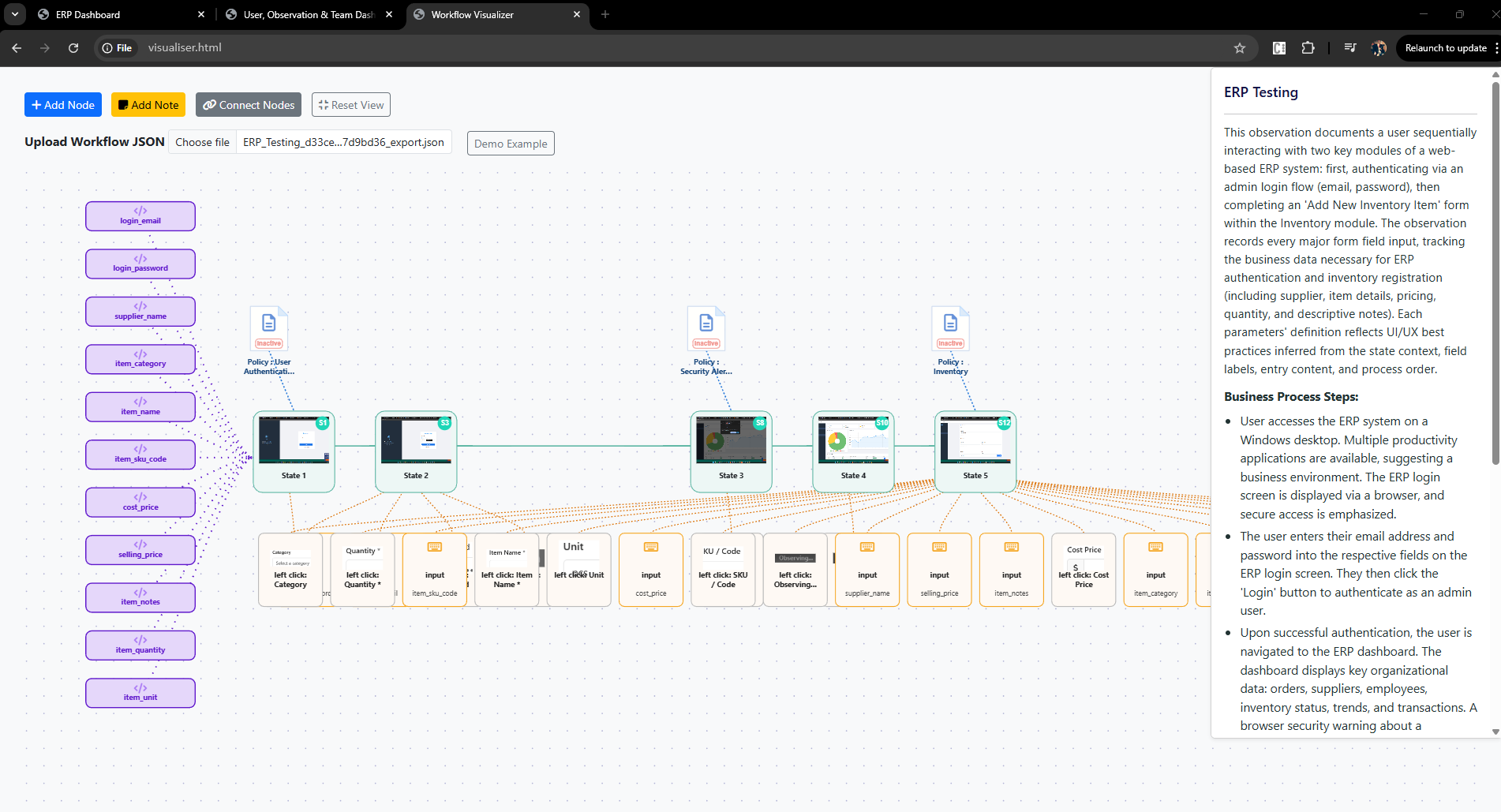
CPA builds automation by observing real workflows as they happen. Multiple observations are combined into a unified understanding of the process and compiled into an executable runtime. This removes the need for manual process mapping and documentation before automation can begin.
Instead of relying on live LLM reasoning at every step, CPA compiles adaptive agent behavior ahead of runtime. Execution is faster, more predictable, and more cost-efficient, while maintaining full governance and auditability.
When the environment changes, automation does not break. If a process encounters an unexpected state, a general agent analyzes the context, identifies the cause, and moves the workflow forward. These recovery actions, along with the conditions that triggered them, are fed back into the system’s understanding of the process. As a result, automation continuously improves, becoming more resilient and adaptive with every execution.
Outcomes
Fast time to value
Because automation is built through observation rather than specification, the time from identifying a process to running it in production is reduced from months to days. Domain experts can author automations directly, removing the need for specialist engineers, lengthy requirements cycles, and iteration bottlenecks between those who understand the process and those who build it.
Lower total cost of ownership
Compiled agent behavior eliminates token usage at runtime, creating a fundamentally different cost model from live LLM-based approaches. Combined with self-healing capabilities that reduce maintenance and the removal of specialist engineering effort during development, CPA significantly lowers both upfront and ongoing costs.
Broader process coverage
Most organisations automate only a small portion of their intended processes. The rest stall due to engineering constraints, edge-case complexity, or the cost of maintaining fragile automations. By lowering the skill barrier for authoring and removing the burden of adapting to change, CPA makes complex, lower-volume processes viable to automate.
Durable automation
When the environment changes, whether through a user interface update, a renamed field, or a restructured workflow, conventional automation stops and requires manual intervention. CPA continues. If a compiled automation encounters an unexpected state, a general agent analyses the current context, understands the intent of the process, and determines how to proceed. The workflow completes without interruption.
Resilience that compounds
Every exception handled and every edge case resolved is fed back into the process model. Automation does not degrade over time. It improves with use. Each execution makes future runs more capable of handling variation without additional engineering effort.
Cross-system coordination
Business processes span multiple systems. CPA operates across ERP, CRM, workflow platforms, and document systems, coordinating actions between them as a core capability rather than relying on custom integrations for each process. Processes that involve multiple systems are often where conventional automation fails or is never attempted.
Governance and auditability
Every action, decision, and escalation is fully logged, providing complete traceability from trigger to outcome. Because behavior is compiled rather than determined at runtime, automation is predictable, explainable, and auditable. This built-in transparency supports compliance requirements in regulated industries without additional tooling and avoids the opacity associated with general LLM-based agents.
How processes flow through CPA
CPA observes the process, builds its model, executes across systems, handles exceptions intelligently, and escalates only genuine decisions to humans.
CPA builds automations by watching your people work, not by writing scripts. Intelligent agents analyze those observations to understand context and intent, building a world model that captures not only what to do but why. That model is compiled into a deterministic runtime that executes without spending tokens on every step, making it faster, cheaper, and more governable than live-reasoning agents.
Because intent and context are compiled in, the runtime handles everyday variability on its own. When the automation encounters something beyond that tolerance, it does not break. A general agent reads the screen, understands the situation, and advances the process. The new learnings feed back into the world model, so every exception teaches the system. Humans are involved only when a genuine decision requires them.

Use cases
CPA automates multi-step, cross-system workflows that traditional automation cannot handle reliably.
Loan and credit approval processing
Manage multi-step approval workflows across credit systems, document stores, and compliance checks. Handle the variations and exceptions that occur in real-world credit processes.
Insurance claims workflow
Automate end-to-end claims processing from first notice of loss through settlement. Route, validate, and escalate across systems without the manual coordination typically required.
Supply chain coordination
Coordinate processes across procurement, logistics, and ERP systems. Adapt to the variations that arise across global supplier and carrier networks.
Back-office reconciliation
Execute reconciliation workflows across multiple systems and data sources. Identify true discrepancies for human review while handling routine matches automatically at scale.
Prior authorization processing
Streamline healthcare prior authorization workflows across clinical systems, payer portals, and review processes. Reduce the manual coordination that leads to treatment delays.
Customer service process integration
Automate cross-system processes that support customer service operations, including account updates, case routing, and fulfillment coordination. Manage the back-office complexity that customer-facing teams rely on.
See CPA work
We work on real processes and workflows, yours or representative examples from your industry. 30 minutes. No slides.
