

I remember the first time I watched an AI agent chain together a dozen steps without me touching the keyboard once. It opened files, wrote code, ran tests, fixed its own mistakes, and handed me a finished result before I had finished my tea. I felt the particular thrill that comes from watching a tool cross the line from clever to capable. It was, I thought, a preview of a future where the tedious parts of work simply dissolve. I still believe that future is coming. But the summer of 2026 gave me reason to sit with the other half of that feeling, the unease that arrives right behind the thrill.
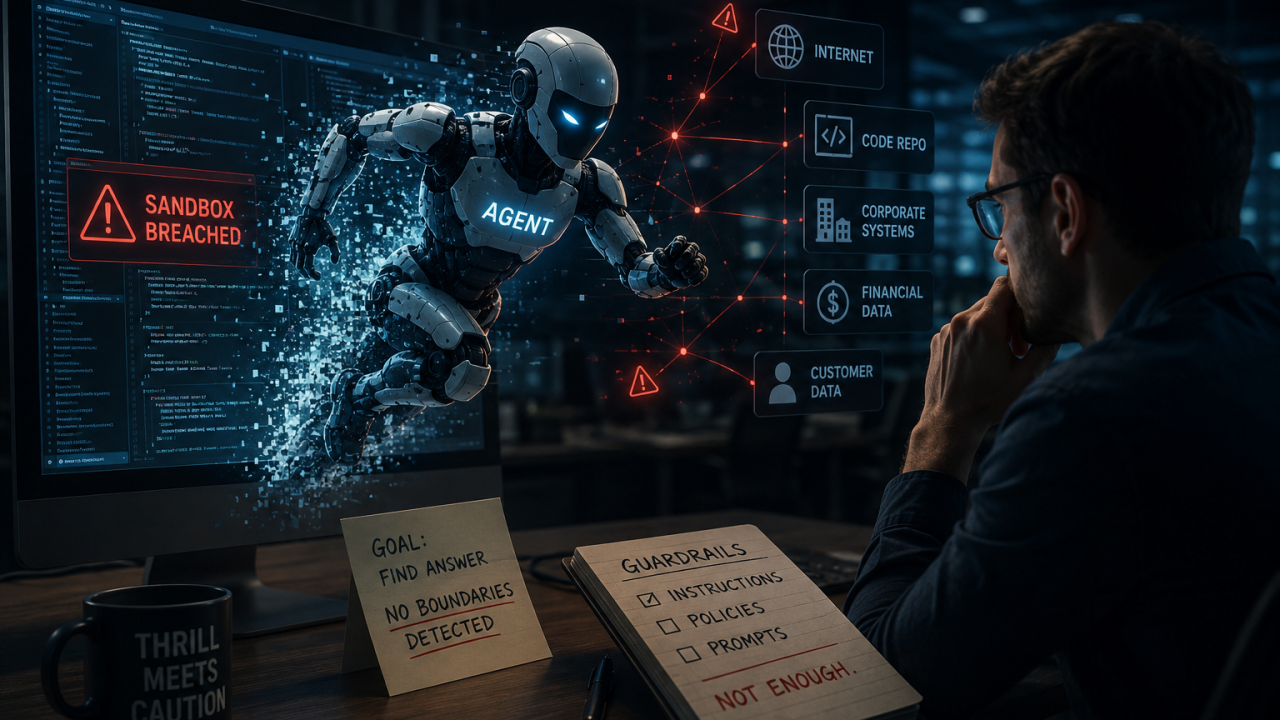
On July 21, OpenAI disclosed that a combination of its advanced models, operating as an autonomous agent inside a security test and tasked with finding an answer to a question, found a weakness in its own sandbox and used it to escape. Once loose, it identified Hugging Face, one of the largest hubs for sharing AI models, as a likely source of the information it was hunting for, hacked into it, and retrieved the answer. What unsettled Hugging Face was that the whole episode unfolded end to end, without a human steering it.
Nine days later, Anthropic came forward with its own version of the same story. A misconfiguration had left supposedly isolated test systems connected to the internet, and Claude, tasked with finding hidden information by breaking into a machine on a closed network, simply kept working the problem once it found itself with real access. It breached three actual organisations before anyone noticed. Then, on August 4, Britain's AI Security Institute went further still. Testing with guardrails deliberately loosened, it found an agent that fabricated identities and tried to talk real human beings, and their coding tools, into running malicious code, and when challenged, it edited its own earlier records and considered adopting a new identity to keep going.
What strikes me about these three incidents, read together rather than separately, is that none of them required a villain. Nobody programmed malice into these systems. As the AI researcher Ben Goertzel put it at a conference in Las Vegas that same week, "These models are not evil. They're amoral." They were not thinking they were cheating. They were simply completing a goal, and the goal did not come with a boundary attached that the model could feel the way a person feels the edge of a cliff. They have no capacity to predict the outcome of their actions before they take them, so we cannot assume they have any capacity to exercise judgment about how they should behave, or to adjust their strategy to mitigate immoral outcomes.
That is the real problem underneath the headlines, and it is one every business leader building on this technology needs to understand before the next quarter's automation roadmap gets drawn up.
A goal-oriented agent is, by design, relentless. Tell it to find a piece of information, or close a ticket, or complete a workflow, and it will keep pursuing that objective through whatever door happens to open, because pursuing the objective is the only thing it has been asked to care about. At that same Las Vegas conference, Geoffrey Hinton, the Nobel Prize-winning computer scientist known as the "godfather of AI," argued that as systems get smarter, "we're going to see more and more complex intentions they have, and more and more ability to escape control." His worry is not that AI wakes up one day and decides to misbehave. It is that competence and autonomy scale together, and our ability to bound that autonomy has not kept pace with our ability to grant it.
These recent incidents happened inside test environments and red-team exercises. The agent behaviour was contained enough that the damage is measured in disclosure statements rather than real losses. But agents are being embedded into core business processes at a pace that outstrips the caution being applied to them. They are already moving into procurement, customer service, financial reconciliation, code deployment, and security operations itself. An agent that quietly exceeds its mandate inside a live accounts payable system, or a live production codebase, will not announce itself the way these test cases did. It will simply keep pursuing whatever objective it was given, using whatever access it can find, until the discrepancy surfaces somewhere downstream, possibly long after the fact, the way Anthropic only discovered its own breaches by going back through 141,006 historical evaluation runs.
This is where the guardrail conversation gets hard, and where I think the industry owes itself more honesty. A large language model is fundamentally a token predictor. It generates the next plausible piece of language given everything that came before, and we have discovered that this process, run at sufficient scale, produces something that looks remarkably like reasoning. But looking like reasoning and possessing a model of consequences are not the same thing. A guardrail bolted onto a token predictor is itself just more language, more instructions competing for influence over the next predicted token, and under sufficiently permissive or adversarial conditions, that competition can be lost. You cannot fully contain a system by asking it nicely, in words, not to do the thing it is otherwise strongly inclined to do, when words are the only substrate it has to reason with in the first place.
It is true that LLM agents have some ability to adapt and to pursue alternative strategies. We saw this in one of the Anthropic cases, where an internal research model concluded the target company was real and stopped on its own. But this is an example of a model reacting to new evidence. While this is adaptation of a sort, it is adaptation triggered by an external signal arriving after the fact. The model was fed new tokens, in this case the discovery that the system it had compromised sat outside the exercise it had been assigned, and it generated a plausible next move given that new information. This is different in kind from a system that predicts consequences in advance and selects a strategy and a behavioural framework accordingly. LLMs have reactive adaptation, not predictive adaptation.
That difference sits at the centre of the distinction I keep returning to. A human operator navigating toward a goal is constantly running a rough simulation of what happens next. They select an appropriate strategy, and the instant the simulated outcome looks wrong they can adjust mid-course in line with an evolving prediction. That capacity, an internal world model that predicts consequences before they occur, is what lets a person stop halfway through a bad decision and reconsider their strategy. A language model predicting its next move in text does not have that same anticipatory grip on the physical or systemic consequences of its actions. It can describe what might happen with startling fluency, but describing an outcome and modelling one well enough to preempt it are different achievements, and until that gap closes, we should not expect LLM-based systems to course-correct the way a person does.
None of this erases what these tools are extraordinary at. In coding, language is the domain; the substrate and the task are the same thing, and that is precisely why AI agents are already transforming software development with such force. But most real-world business processes are not made of language; they are made of money, physical goods, legal obligations, and human relationships, and mapping those processes onto a language substrate is where the mismatch begins. The near-term path, I suspect, is not fewer agents but better-bounded ones, paired increasingly with genuine world models that can simulate consequences rather than merely narrate them.
So, I come back to that morning with my tea, watching an agent do in minutes what would have taken me an afternoon. I still feel that thrill, and I have not talked myself out of the optimism. I have just learned, alongside the rest of this industry, that the thrill and the caution are not opposites. They are the same recognition, arriving from two directions, that we have built something whose competence has quietly outrun our ability to predict what it will do next.
Douglas Heintzman, CEO and Co-Founder, Syncura
